
You Cannot Copyright an Idea, Only the Way You Express It
A founder reads about a clever subscription app, loves the concept, and builds a similar one with their own code, their own screens, and their own wording. A novelist borrows the premise of a famous story, two rivals from feuding families who fall in love, and writes a completely new book around it. A trainer takes a well-known productivity method and teaches it in a course written entirely in their own words. In all three cases the same question lands on a lawyer's desk: have I infringed someone's copyright? In all three cases the honest answer is usually no, and the reason is one rule that almost everyone gets wrong.
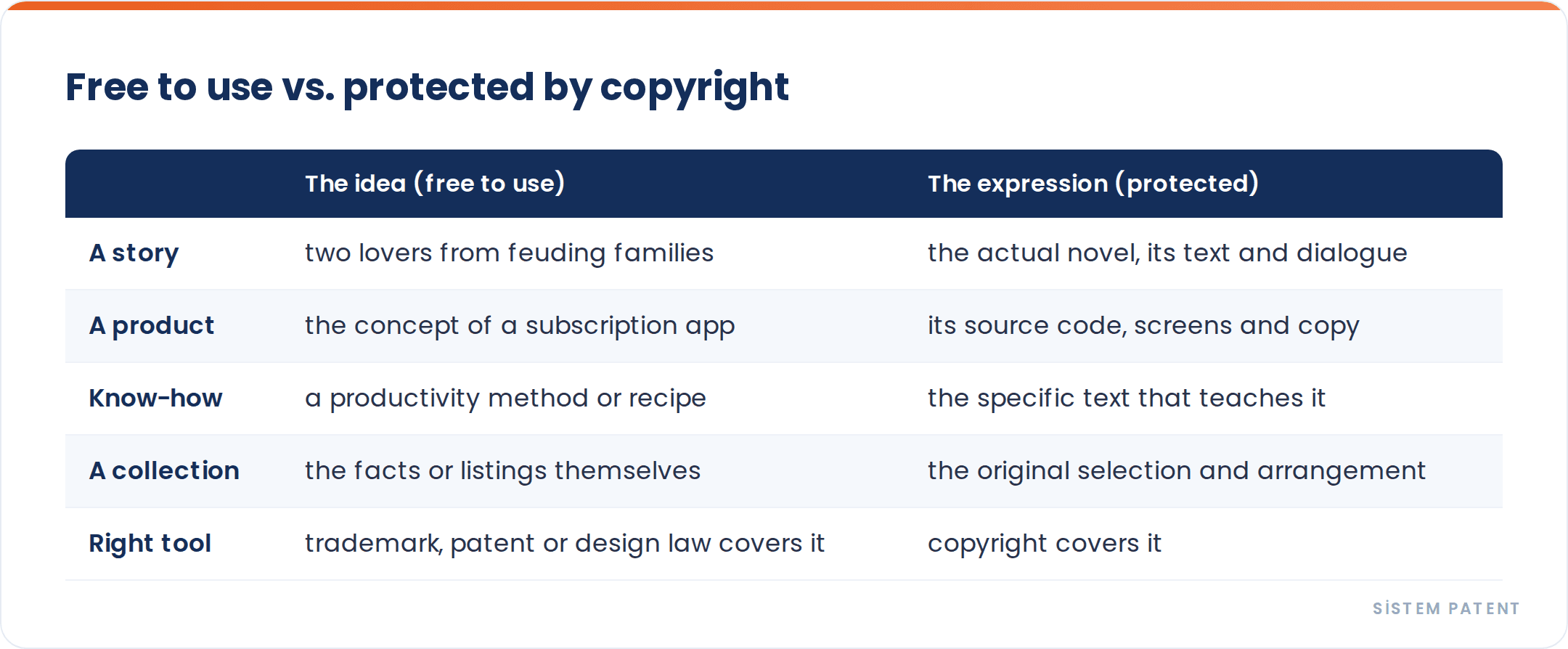
Copyright does not protect ideas. It protects the particular way an idea has been expressed. The concept, the premise, the method, the system, the format, the plot in the abstract: those sit in the open and anyone is free to use them. What the law fences off is the concrete form the author gave them, the exact text, the specific arrangement, the actual images and code. This is the idea-expression line, and it decides far more disputes than people expect.
The law protects the work, not the thought behind it
Turkish copyright sits under the Law on Intellectual and Artistic Works (Law No. 5846). It protects works: literary, musical, fine-art and scientific works that carry the personal stamp of their author and exist in some perceptible form. The protected thing is the work as created, not the underlying notion that prompted it. An author who writes a cookbook owns the text of the recipes, the photographs, the headnotes and the layout they wrote. They do not own the idea of cooking that dish, and they cannot stop anyone else from writing a different cookbook about the same food.
The same principle runs through the major copyright systems, which is why it travels so well across borders. International copyright treaties administered through WIPO (the World Intellectual Property Organization) protect expression, and several explicitly state that protection does not extend to ideas, procedures, methods of operation or mathematical concepts as such. A business plan, a marketing strategy, a recipe in the sense of the dish itself, a game mechanic, a teaching method: these are ideas. Write them down and your particular write-up is protected as text. The thinking inside it stays free for the next person to use and describe in their own words.
There is a practical reason the line is drawn here, not somewhere more generous to the first author. If the first person to write a detective story could own the idea of a detective story, the whole genre would belong to one estate. If the first person to describe a workout could own the exercise, every gym would owe them a fee. Copyright deliberately leaves the raw material of culture and commerce in common hands and rewards only the labour of giving it a specific shape. That trade-off is the engine of how creative and commercial work builds on what came before.
Where the copy actually crosses the line
So if ideas are free, when is a copy infringement? The answer is when the second work takes the protected expression of the first, not merely its concept. Lifting the text of an article and republishing it, even with light edits, is copying expression. Translating a novel without permission copies its expression into another language. Reusing the source code of a program, the photographs from a campaign, or the actual wording of a contract template all cross the line, because in each case what was taken was the concrete form the author created, not the abstract idea behind it.
The hard cases live in the middle, and they turn on how detailed the borrowing is. A plot summarised in one sentence is an idea. A plot reproduced scene by scene, with the same sequence of events, the same distinctive characters, the same turning points and the same structure, can amount to copying expression even if not a single sentence is identical. As you move from the broad theme down toward the specific selection and arrangement of detail, you cross from the free zone into the protected one. Courts look at how much of the protected detail survives in the second work and whether an ordinary observer would recognise it as taken from the first.
Selection and arrangement can be the expression
Expression is not only the literal words. The way a creator selects, orders and arranges material can itself be protected when those choices reflect a real authorial decision rather than an obvious or dictated one. A directory that simply lists every business in a town alphabetically expresses almost nothing, so copying the listings is generally not infringement of expression. A curated guide that chooses which places to feature, groups them in an original way, and writes original descriptions has expression in that selection and arrangement, and reproducing the curation can infringe even if the underlying facts are public.
This is why two competitors can publish price lists of the same products without copying each other, but cannot lift one another's product photography, descriptive copy, or the distinctive structure of a catalogue. The facts and the idea of a catalogue are open. The specific creative execution is not. When a dispute is unclear, the right move is rarely to argue alone over whether a line was crossed; it is to get a proper read on the work from someone who handles intellectual property rights day to day, because the answer depends on detail, not instinct.
Why founders and creators keep getting this wrong
The myth that you can own an idea causes two opposite mistakes, and both are expensive. The first is overconfidence about being copied. A startup sees a competitor launch a similar product or a similar landing page and assumes copyright gives them a claim over the concept. It usually does not. The concept of the product is free, and unless the competitor took protected expression, the copied app screens, the lifted code, the verbatim text, there is no copyright case at all. The protection a business actually has over its name and brand comes from trademark law, and the protection over how a product works comes from patent or design rights, not from copyright over an idea.
The second mistake is the mirror image: paralysis about building on what exists. Creators hold back from writing in a popular genre, teaching a known method, or entering a crowded category because they fear infringing the originator. They are usually free to proceed, as long as they create their own expression rather than copying someone else's. Once you grasp where the line sits, you can use the world's stock of ideas with confidence while staying clear of the one thing that does get you sued, taking another author's actual work.
There is a defensive lesson in this too. Because copyright protects expression and arises the moment a work is fixed in a tangible form, your own original text, designs, code and images are protected from the instant you create them, with no filing required. A formal registration is not what creates the right, but it gives you a dated, official record that you authored the work, which makes enforcement far easier when someone does copy your actual expression. For work you expect to defend, putting an official copyright record in place turns a claim you would have to prove from scratch into one you can show on paper.
Protect the expression you made, not the idea you had
The line is simple to state and easy to misjudge in the moment. Ideas, methods, plots, systems and formats belong to everyone. The specific text, images, code, music and the original selection and arrangement of detail belong to the author who made them. A copy infringes when it takes the second, not the first. Hold that distinction and most copyright panic, and most copyright overreach, falls away.
If you are sitting on work you genuinely want to defend, original writing, software, designs or creative material, the practical step is to make sure your authorship is documented and protectable. Sistem Patent can review where your work sits on the idea-expression line and help you register your copyright so the expression you created is yours on the record, not just in principle.
Picked for You
Related Articles
Who Owns Your Reels: A Creator's Guide to Copyright, Music and Brand Deals
Read More →
Work-for-Hire and Freelancers: Who Owns the Design, Code or Copy You Paid For
Read More →