

What a Software Copyright Registration Actually Proves When You Sue

Two software companies end up in front of a judge. One says the other lifted its code. It pulls out a copyright registration certificate, slides it across the table, and expects the case to be over. It is not over. The certificate matters, but not in the way most founders imagine. It does not announce a winner. It changes who has to prove what, and that single shift is the real reason to have it before a dispute ever starts.
A software copyright record in Turkey is one of the most misunderstood documents a technology business can hold. Some founders treat it as a magic shield that ends any argument. Others dismiss it as a meaningless piece of paper because copyright already exists the moment you write the code. Both readings miss what the record actually does in a courtroom. It is evidence, specific evidence, with a specific job, and knowing the limits of that job is what separates a useful filing from a false sense of safety.
The record proves authorship and a date, nothing more
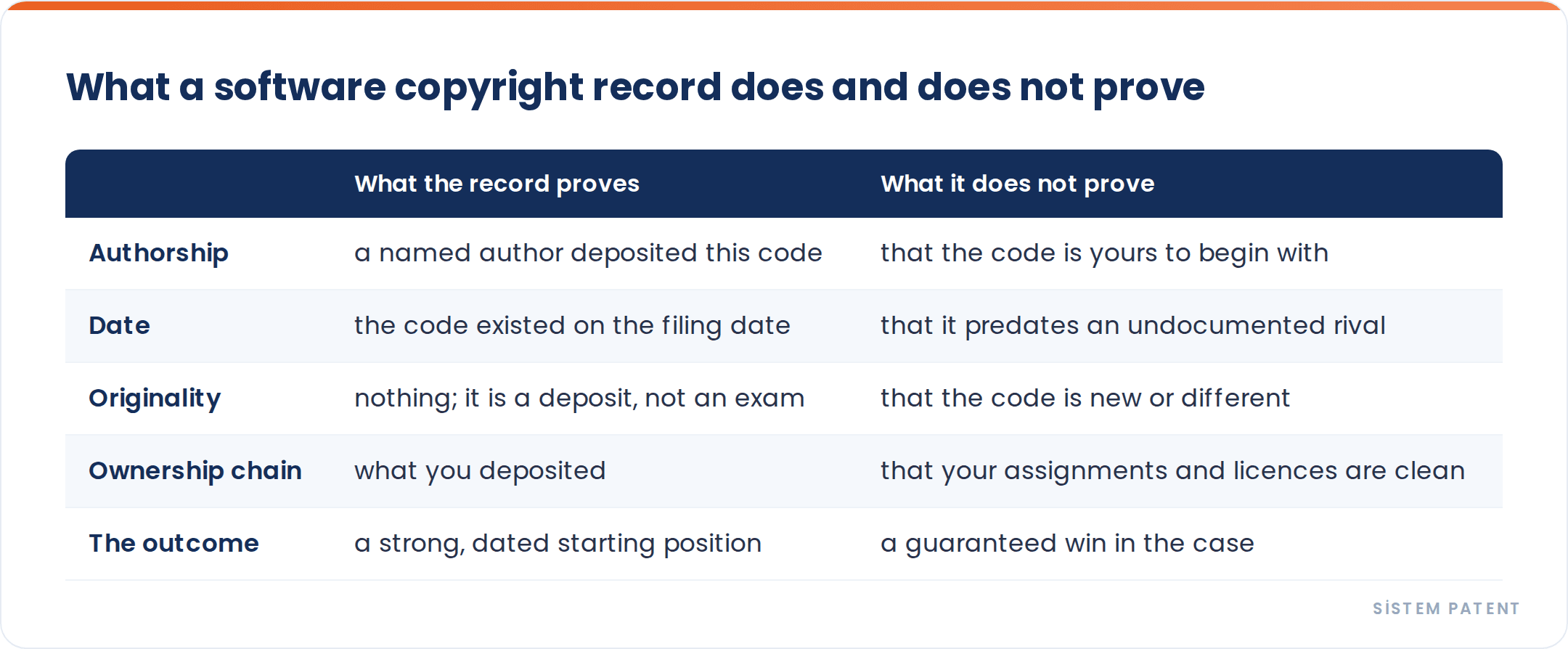
Under the Law on Intellectual and Artistic Works (Law No. 5846), copyright in software arises automatically. The moment your developers fix original code in a tangible form, it is protected, with no registration required. So what does a formal record add, if the right already exists without it? It adds proof. The registration creates a dated, official statement that a named author deposited this particular code on this particular day. That is its entire contribution, and it is more valuable than it sounds.
Think about what you would otherwise have to establish in court with no record at all. You would need to prove that your team wrote the code, that it existed in its current form before the defendant's product appeared, and that you are the rightful owner. Without documentation, every one of those points is open to challenge, and you are reconstructing history from commit logs, employee memories and invoices years after the fact. The record collapses that reconstruction into a single dated certificate. It says, on an official footing, here is the work, here is who deposited it, here is when.
What the record does not do is just as important. It does not examine your code for originality the way a patent office examines an invention. Nobody checks whether your software is new, clever or different from what already exists. A copyright record is a deposit, not a quality verdict. It says this is the code you registered on this date. It says nothing about whether that code is good, original enough to protect, or free of material copied from someone else. The protection still depends on the work genuinely being your own original expression, and the record cannot manufacture that if it is missing.
Why the burden of proof is the whole game
In a code-theft case, the fight is rarely about the law in the abstract. It is about who carries the burden of proving the facts, and the side that carries it is the side at risk of losing when the evidence is thin. This is where a registration earns its keep. Without one, you are the one who must prove, from scratch, that you authored the code and that it predates the copy. With one, you walk in holding an official, dated record that already establishes those facts on their face, and the practical pressure shifts to the other side to explain how their near-identical code came to exist.
That shift is not a formal reversal of the legal burden in every situation, and it would be wrong to promise that a certificate flips every rule of evidence. What it does in practice is give you a credible, dated starting point that is hard to wave away. A defendant who copied your code now has to account for the resemblance against a documented record of your prior authorship. That is a far weaker position than facing an opponent who has nothing but assertions. Disputes settle on the strength of positions, and a dated record strengthens yours before a single argument is made.
This is why the timing of the filing matters so much. A record created today proves your authorship as of today. It does nothing for code you wrote two years ago if a competitor releases a copy tomorrow and claims they had it first, because on paper your evidence only begins now. The value of the record is front-loaded: it is worth most when it is oldest. A business that registers its core codebase early, and updates the record as the software evolves, builds a timeline that is genuinely hard to attack. One that waits until it is already being copied has a much thinner story to tell.
What the record cannot rescue
A registration cannot save a claim that has a problem at its foundation. If parts of your code were copied from an open-source project under a licence you did not honour, the record does not cleanse that. If a freelancer wrote the code and you never took a written assignment of rights, your registration may name the wrong owner, and an opponent will attack exactly there. The certificate documents what you deposited; it does not audit how you came to own it. The chain of ownership behind the code, the employment terms, the contractor assignments, the open-source compliance, all of that still has to be sound. A clean record sitting on top of a broken ownership chain is a liability dressed as protection.
Where the record fits in a real enforcement plan
A copyright record is one layer, and on its own it rarely wins anything. It is the evidentiary anchor that the rest of an enforcement effort is built on. When you decide to act against a copy, the first question your lawyers face is what you can prove and how fast. A dated record answers a large part of that immediately, which is why an intellectual property infringement lawsuit backed by registered work moves from a standing start far more smoothly than one that has to assemble proof of authorship while the clock runs.
For software specifically, the record works best as part of a wider protection map rather than a single move. The code is one asset; the interface, the name, the underlying inventions may each call for different rights. Putting a formal software copyright registration in place gives the code itself a dated owner of record, and it pairs naturally with documenting your other works the same way. Many businesses extend the same discipline to their broader creative output, securing a dated work registration record for the materials they expect to defend, so that every asset they might one day litigate over already has its authorship on file rather than waiting to be proven.
The honest summary is that a software copyright registration is a strong, narrow tool. It proves who and when, it shifts the practical pressure onto a copyist, and it turns a story you would have to build under deadline into one you can show on paper. It does not prove your code is original, it does not guarantee a win, and it cannot repair a faulty ownership chain. Used with those limits in mind, and filed early rather than in a panic, it is one of the cheapest forms of protection a software business can put on the record.
If you are building something you would one day defend in court, the practical step is to put that dated record in place now, while it is still the oldest evidence you can create. Sistem Patent can review where your code and its ownership chain stand and help you register your software copyright so that, if a dispute ever comes, your authorship is already on the record instead of something you have to prove from memory.
Picked for You
Related Articles

Who Owns Your Reels: A Creator's Guide to Copyright, Music and Brand Deals
Read More →
Work-for-Hire and Freelancers: Who Owns the Design, Code or Copy You Paid For
Read More →