
Search the Design Registers Before You File and Before You Launch
A furniture studio in Istanbul finishes a new chair: a cantilever frame with a woven seat and a distinctive armrest curve. The team is proud of it, the photos go out to retailers, and a pre-order page goes live. Two weeks later a distributor forwards a screenshot. A registered design from another company, filed eighteen months earlier, shows almost the same silhouette. The studio has not copied anything. It simply never looked. Now it has a product on the market that may infringe someone else's right, and a design of its own that can no longer be called new.
This is the scenario a design search is built to prevent, and it solves two separate problems at once. The first is your own novelty: a design only registers if it is new and has individual character, so you need to know whether something identical is already out there before you file. The second is freedom to operate: even a perfectly novel design can still walk straight into a competitor's existing registration, and that exposes you to an infringement claim no matter how original your work felt. One search, two questions. Most people only think about the first and get ambushed by the second.
Novelty clearance and freedom to operate are two different questions
It helps to keep these apart, because they look at the same databases for opposite reasons.
A novelty search asks: has my design, or one that differs only in immaterial details, been made available to the public before my filing date? This is about protecting your application. Under the Industrial Property Code (Law No. 6769), a design is registrable only when it is new and produces a different overall impression on the informed user. If an identical design already sits in a database, a journal, or a shop window, your registration is vulnerable from day one. Anyone can later ask TURKPATENT (the Turkish Patent and Trademark Office) to invalidate it on exactly that ground.
A freedom-to-operate search asks the opposite: does my product infringe a design that someone else already holds? Here the target is live, in-force registrations belonging to other parties. Your design can be genuinely new and still produce the same overall impression as a registered design owned by a competitor. Novelty protects your right to register. Freedom to operate protects your right to sell. Clearing one does not clear the other.
The reason both matter before launch is timing. A novelty problem found before you file saves the cost of a registration that would not survive a challenge. A freedom-to-operate problem found before you launch saves something far more expensive: a product recall, unsold inventory, and a demand letter that arrives after you have committed to tooling and a marketing campaign.
Where registered designs actually live: national, EU, and Hague
A design that blocks you in Turkey does not have to be a Turkish registration. Three layers of register can reach the Turkish market, and a search that checks only one of them is half a search.
The national register at TURKPATENT
The first place to look is the Turkish design register itself. TURKPATENT publishes designs in its official bulletin, and its online search lets you check the national database for registrations and applications. This is where most direct conflicts with local competitors show up, and it is the register your own application will join.
The EU register at EUIPO
Registered Community designs, administered by EUIPO (the European Union Intellectual Property Office), cover the entire European Union through a single registration. For a Turkish business these matter in two directions. If you export to Europe, an EU design held by someone else is a direct obstacle to selling there. And because so many products circulate between Turkey and the EU, an EU registration is part of the realistic competitive landscape even before you cross a border. EUIPO's DesignView tool aggregates designs from dozens of national offices alongside the EU register, which makes it the closest thing to a single window on the field.
The international layer: the Hague System
The Hague System, run by WIPO (the World Intellectual Property Organization), lets an owner register a design in many countries through one international application. A Hague registration can designate Turkey, the European Union, and a long list of other territories. WIPO's Global Design Database lets you search these international filings. Skipping it means missing designs that are protected in your market without ever having been filed at the national office directly.
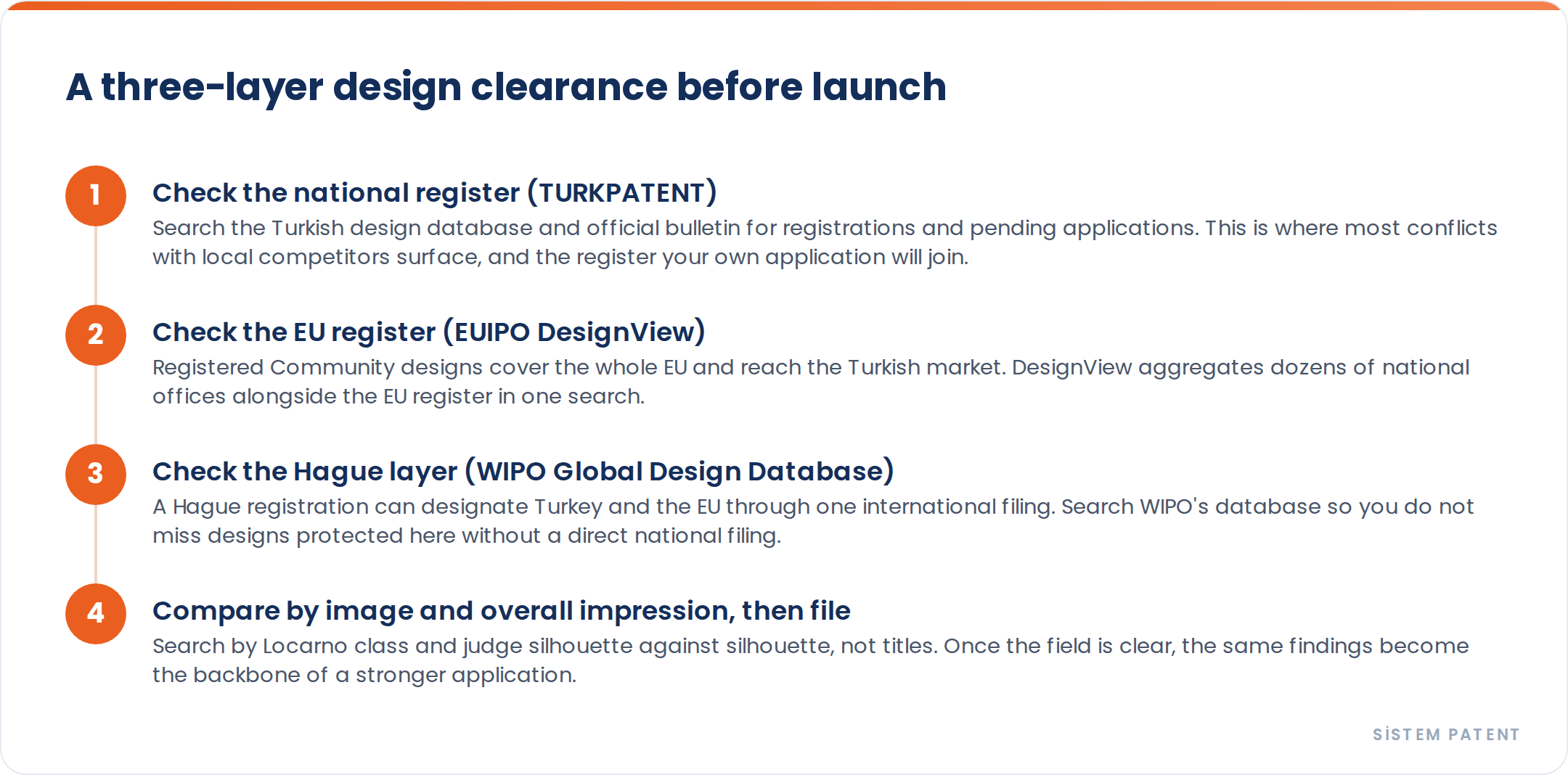
The practical takeaway is that a single national check gives false comfort. A design can be unregistered in Turkey's national database and still be protected here through an EU registration or a Hague designation. Checking all three layers is what turns a quick look into a real clearance.
An exact-match search is not a search
Design conflicts are visual, not textual. You are not looking for the same product name; you are looking for the same overall impression on the informed user. That makes design searching harder than typing a word into a box.
Two designs can carry completely different filing references, different product titles, and different applicant names, and still collide because they look alike. A useful search works through the visual field around your product, not just the literal description. In practice that means a few things done together:
- Search by Locarno class, the international classification for the type of product, so you capture the category rather than relying on how a competitor happened to name their filing.
- Look at the images, not the titles. The drawings and views in a registration define what is protected, so the comparison that matters is silhouette against silhouette.
- Account for the informed user's eye. Minor cosmetic differences rarely create a different overall impression, so a design that is close but not identical can still be a blocker.
- Weigh the designer's freedom in a crowded field. Where function constrains the form, small differences count for more, and the clearance bar shifts accordingly.
This is also where an attorney firm earns its place. Reading whether two designs produce the same overall impression is a legal judgment, not a pixel comparison, and it is the same judgment an examiner or a court would later apply. A results list is only useful once someone can tell which hits are genuine risks and which are noise.
Search before you file, and again before you launch
The cleanest discipline is to treat the search as two checkpoints rather than one event.
Run the first pass before you commit to the design direction, while changes are still cheap. If a near-identical registration turns up, you can adjust the form, reshape the distinctive features, or pick a different concept long before any money goes into tooling. A search at this stage is as much a design tool as a legal one: it tells you where the white space is.
Run the second pass before public launch and before filing, as a final clearance. Markets move, and a registration that did not exist when you started a six-month development cycle may exist by the time you ship. This pass confirms both that your design is still new enough to register and that nothing in force blocks the sale. Keeping the disclosure private until this point matters too, because publishing or showing the design early can destroy the very novelty you are trying to protect.
Once the field is clear, the search feeds directly into the application. The classes you checked, the prior designs you ruled out, and the features that make your product distinct all become the backbone of a stronger filing. You can see how that filing works on our industrial design registration page, and the practical mechanics of protecting an individual product's appearance on our design registration page.
The studio at the top of this article did everything right except look first. A search across the national, EU, and Hague registers before that chair went public would have cost a fraction of what an infringement dispute does, and it would have confirmed whether the design was even registrable. If you are preparing to launch a product whose appearance is part of its value, the sensible first move is a proper clearance, then a design registration built on what it found.
Picked for You
Related Articles
Registered vs Unregistered Design Rights: What You Get for Free and Why It Is Rarely Enough
Read More →
Turn Your Design Investment Into a Tax Position: Design Centres, R&D and IP Incentives
Read More →