
What actually counts as an industrial design
A drinks brand spends two years perfecting a bottle. The curve of the glass, the proportion of the neck, the embossed pattern near the base. Six months after it hits the shelves, a competitor copies the silhouette almost exactly and sells it for less. The brand calls a lawyer and asks the obvious question: what, legally, did we actually own here? The answer is the part everyone underestimates. They owned the look, and only if they registered it.
Industrial design is the right that protects the appearance of a product. Not the idea behind it, not the engineering inside it, the visible result a customer sees and reacts to. In Turkey it sits under the Industrial Property Code (Law No. 6769) and is examined by TÜRKPATENT (the Turkish Patent and Trademark Office). The register works the same way the European system does, which is why the correct term is Industrial Design. The US-style label that pairs the word patent with design belongs to a different legal mechanism and does not apply in Turkey.
Appearance is the whole point, and it is broader than people expect
When people hear design they picture a logo or a product photo. The protectable scope is wider. An industrial design can cover the shape and contours of a product, its lines, its surface texture or pattern, ornamentation, colours, the material's visual effect, and the way those features combine into an overall look. It reaches packaging and labelling. It reaches typefaces. It reaches graphical user interfaces and the icon set inside an app, the layout of a screen, the arrangement of elements a user looks at.
What it does not cover is how the thing works. A bottle's silhouette is a design; the valve mechanism that lets it pour without dripping is not. A chair's form is a design; the folding hinge that makes it collapse flat is not. If the value of your invention is in the function, the appearance right is the wrong tool, and you want a patent or a Utility Model instead.
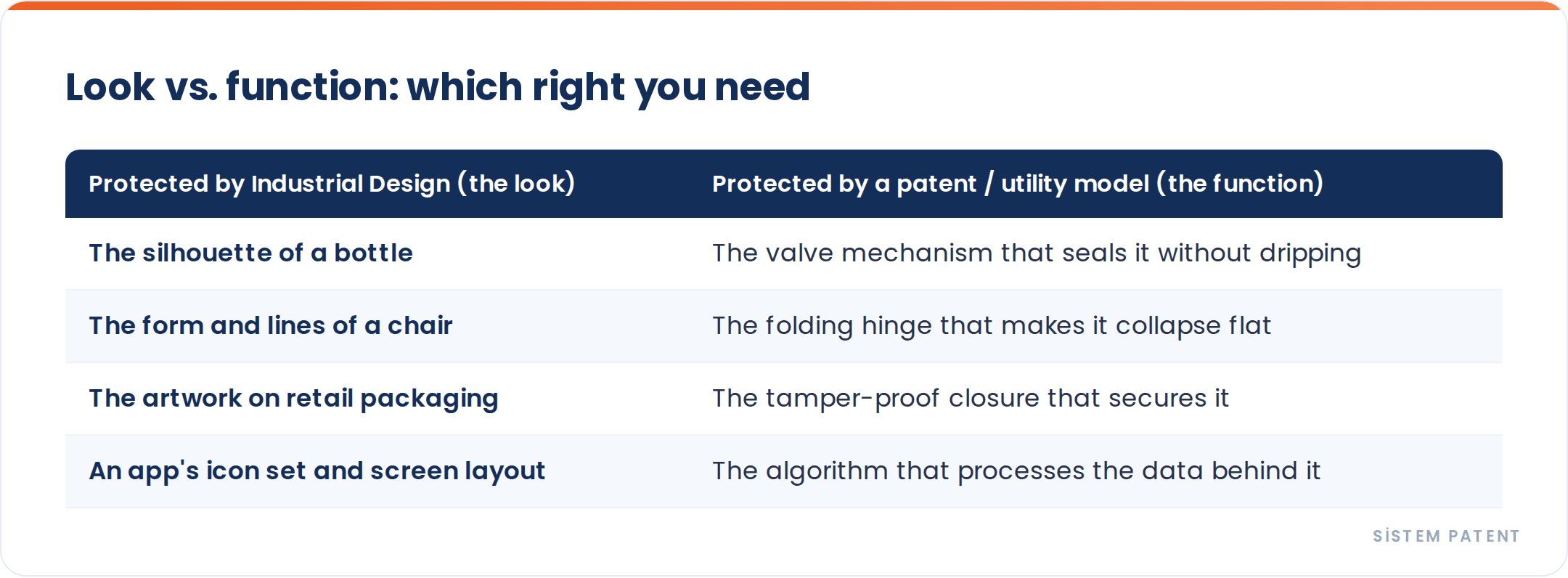
That line between look and function is the single most useful thing to understand before you file. Features that exist purely because the product has to work a certain way, the parts dictated solely by technical function, fall outside design protection precisely so that one company cannot use a design registration to monopolise an engineering solution. The look is yours. The working principle belongs in the patent system, where it is judged by different rules.
Two tests decide whether a design can be registered: novelty and individual character
A design qualifies for protection when it is new and when it has individual character. Both have to be satisfied, and they are not the same test.
Novelty means that no identical design has been made available to the public before your filing date. Identical here is read strictly. Designs that differ only in immaterial details are still treated as the same design, so a token tweak does not rescue something that already exists in the market.
Individual character is the more interesting requirement. Your design must produce a different overall impression on the informed user than any earlier design does. The informed user is not a casual shopper and not a specialist engineer. Think of someone who knows the category well, who has seen the range of bottles or chairs or app screens already on the market and notices the difference between them. If that person would look at your product and an existing one and register them as the same overall impression, your design lacks individual character. The assessment also weighs how much freedom the designer had: in a crowded field where function constrains the form, smaller differences count for more.
The examples a reader already recognises
Industrial design stops being abstract the moment you name real objects. A few that come up constantly in practice:
- The silhouette of a bottle or jar, the shape a customer recognises before reading the label.
- The form of a chair, lamp, or piece of furniture, where the value lives in the line and proportion rather than any moving part.
- A textile or wallpaper print, a repeating surface pattern applied to fabric, ceramics, or packaging.
- Retail packaging and its artwork, the box, the label layout, the way a product presents itself on a shelf.
- An app's icon set and screen layout, the graphical interface a user navigates.
Each of these is an appearance, and each can be registered as a design while the technology behind it travels a separate route through the patent system.
A registered design gives you a right you can actually enforce
Registration converts a good-looking product into a legal asset. It grants an exclusive right to the appearance: the registered holder can stop others from making, offering, or selling a product that produces the same overall impression on the informed user, and can act before that copy takes market share. That is the difference the drinks brand at the top of this article wished it had understood earlier.
Turkey, like the European system, does recognise a form of unregistered design protection, but it is the weaker option. It is shorter in duration and harder to enforce, because you carry the burden of proving when and where your design was first disclosed and that the other party copied it rather than arriving at the same look independently. A registration removes most of that argument. You hold a dated certificate that defines the protected design, which makes a cease-and-desist letter or a court case far more straightforward.
The other advantage is practical: relative to a patent, a design filing is fast and low-cost. A patent has to be examined for an inventive technical step, which takes time and significant fees. A design is examined on the formal and visual requirements, so protection arrives sooner and at a fraction of the outlay. The official fees are set by TÜRKPATENT and revised periodically, so a current schedule should be confirmed at the time of filing rather than assumed.
The protection then runs for a long, renewable term measured from the filing date, renewed in set periods and lapsing only if you let it. It is not perpetual the way a trademark can be, but it comfortably covers the commercial life of most products. A single application can also carry several designs in the same product class, which is what makes registering an entire product family or a seasonal collection in one filing far cheaper than people assume.
Function or appearance: choose the right register, then protect both
The cleanest way to decide is to ask what a competitor would copy to hurt you. If they would copy the look, the shape that makes customers reach for your product, you need an industrial design, and you can read how the filing works on our design registration page. If they would copy how it works, the mechanism or the method, that belongs to the patent system, and our patent registration page covers that route. Plenty of products deserve both, filed in parallel: the form as a design, the working principle as a patent.
The mistake worth avoiding is assuming one right quietly covers the other. It does not. A patent says nothing about whether a rival can imitate your product's appearance, and a design says nothing about whether they can copy its engineering. Knowing which right you actually need, and filing it before the product is public, is the whole game. If you are weighing up the look of a product you are about to launch, the practical next step is a short conversation about design registration and whether a parallel patent belongs in the plan.
Picked for You
Related Articles
Registered vs Unregistered Design Rights: What You Get for Free and Why It Is Rarely Enough
Read More →
Turn Your Design Investment Into a Tax Position: Design Centres, R&D and IP Incentives
Read More →