
Design Right or Trademark for a Logo or Product Shape: Which Register Should You File In?
A founder shows us a freshly designed logo and a curved bottle that will carry it, and asks a question that sounds simple: do we register this as a design or as a trademark? The honest answer is that the same logo and the same bottle can each qualify for both, and the two routes protect different things for different lengths of time. Picking one register over the other, or filing in both, is a decision about what you are actually trying to stop a competitor from doing.
Turkey runs two separate systems for the appearance of a thing. Industrial design protection, governed by the Industrial Property Code (Law No. 6769), guards the way a product looks: its lines, contours, colours, shape, texture, and ornamentation. A trademark protects a sign that tells buyers who a product comes from. A logo is a sign. A distinctive bottle shape can also become a sign once the public reads it as your brand. So a single graphic or a single three-dimensional form can sit in front of two different doors at TURKPATENT (the Turkish Patent and Trademark Office), and each door grants a different kind of right.
The design register protects how something looks; the trademark register protects what it signals
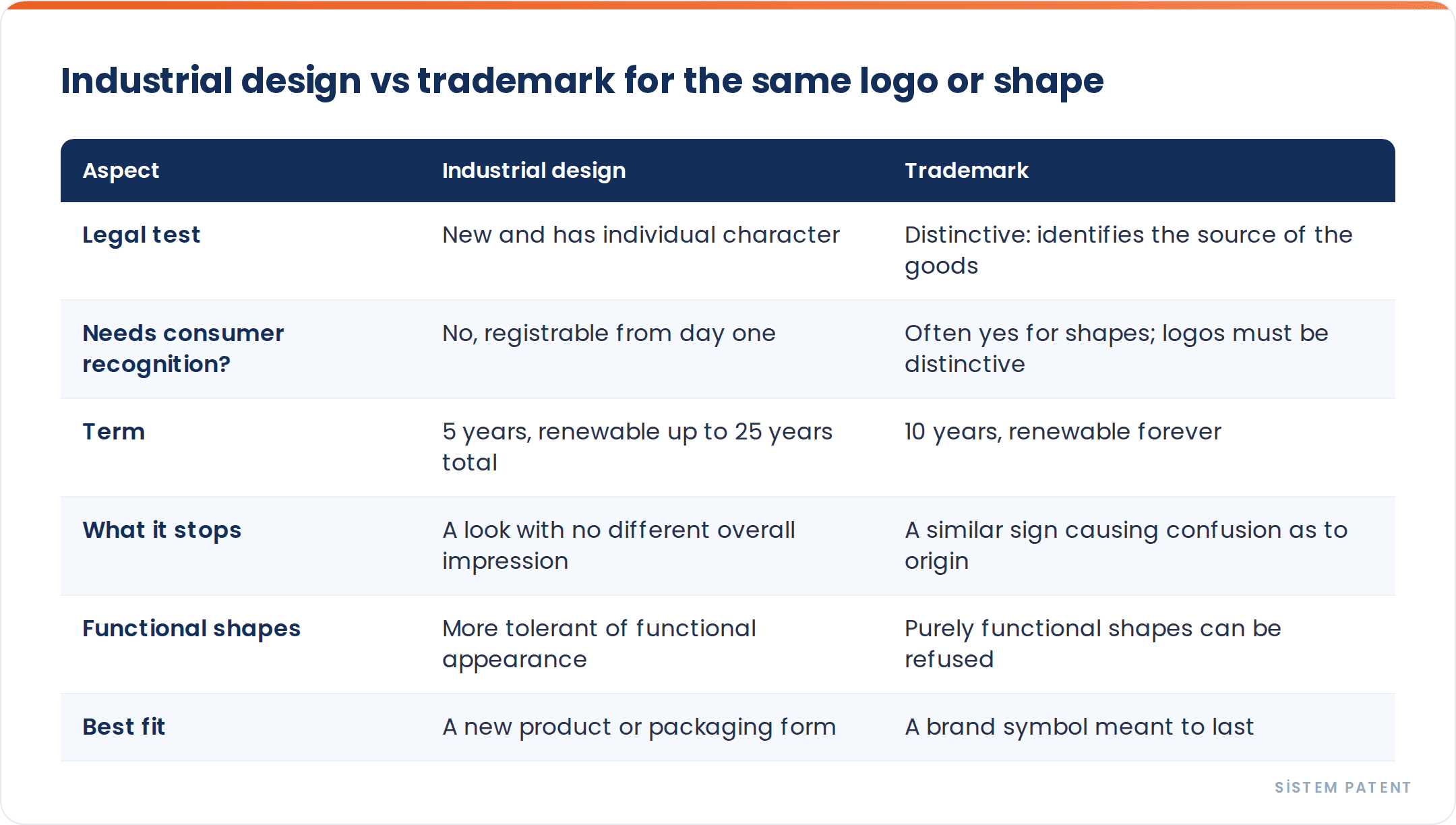
The split matters because the two rights are tested against completely different questions. A design application asks whether the appearance is new and has individual character: has this exact look been made available to the public before, and does it give an informed user a different overall impression from what already exists. It does not ask whether anyone associates the look with your company. You can register a brand-new ornamental pattern on day one, before a single customer has seen it.
A trademark asks the opposite. It does not care whether the shape or graphic is new in the abstract. It cares whether the sign can distinguish your goods from everyone else's. A plain geometric logo may be perfectly novel as a design yet too ordinary to function as a trademark. A product shape often has to prove that buyers already recognise it as a source identifier, which is a high bar that takes years of consistent use to clear. This is why a startup can usually design-register a shape immediately but cannot always trademark it yet.
That difference in the legal test drives almost everything else. It explains why the two rights expire on different schedules, cover different competitor behaviour, and fail in different ways.
Ten years that end versus protection that renews forever
The single biggest practical gap is duration. An industrial design in Turkey is protected for five years from the application date and renews in five-year blocks up to a hard ceiling of twenty-five years. After that the design falls into the public domain and anyone may copy the look. That clock cannot be extended.
A trademark has no such ceiling. It runs for ten years and renews for ten-year periods with no limit, for as long as you keep paying the renewal fee and keep using the mark. A brand that has carried the same logo for fifty years still holds a live, enforceable trademark. The design register was never built to do that. It was built to reward fresh appearance for a fixed commercial window, not to lock up a brand symbol indefinitely.
For a logo you intend to use for the life of the business, that gap is decisive. A design registration on its own would eventually run out and leave the logo unprotected as an identifier. A trademark keeps it alive. For a product shape tied to a specific model or season, the capped design term may be exactly enough, because the product itself will be replaced long before twenty-five years pass.
What each right actually lets you stop
Scope is the other half of the decision. A registered design gives you a right against anyone who uses a product with the same look, or a look that does not produce a different overall impression on the informed user. It is strong against direct copying and near-copying of appearance, and it does not require you to prove confusion. If a rival ships a bottle that looks like yours, the design right speaks to that directly.
A trademark works through the idea of confusion and origin. It lets you stop a competitor whose sign is identical or similar for related goods in a way that could make buyers think the two come from the same source. Its reach follows the goods and services you registered it for, organised under the Nice classification, rather than the raw visual form. A trademark can also bite where a design cannot: against a similar name or logo used on related products even when the overall product design is different, and, for stronger marks, against use that trades on or dilutes your reputation.
The two therefore catch different infringers. A competitor who copies your packaging shape but slaps their own brand on it is squarely a design problem and only weakly a trademark one. A competitor who apes your logo on a different-looking product is a trademark problem that a design right may not touch. Cover the asset with both and you close both gaps.
When a logo or a shape genuinely qualifies for both
Not every visual asset is a real candidate for dual filing, so it helps to be concrete about what is.
A figurative logo
A graphic logo, the kind you put on a sign and a package, is almost always registrable as a trademark because it is built to identify you. It is also registrable as a design when it is applied to a product or its ornamentation, for example as the surface decoration of an item. For a pure brand symbol, the trademark is the load-bearing right and the design filing is a supplement that can be useful against ornamental copying in the early years.
A three-dimensional product or packaging shape
This is where dual filing earns its keep. A distinctive bottle, a container, a uniquely formed product: each can be design-registered the moment it is new, and the design right gives you immediate, confusion-free protection while the shape is still young and has no consumer recognition behind it. Over time, as buyers come to read the shape as your brand, you build the case to register the same shape as a three-dimensional trademark and gain protection that never expires. One important limit applies on the trademark side: a shape that results purely from the product's technical function, or that gives substantial value by its form alone, can be refused as a mark. The design register is more forgiving of functional appearance, which is another reason the two are complementary rather than interchangeable.
Why mature brands file both instead of choosing
Read together, the two rights form a relay. The design registration covers the gap at the start, when the look is new but unknown, giving you a clean right against copyists from the first day without any need to prove reputation. The trademark takes over for the long haul, protecting the same logo or shape as a source identifier for as long as the brand lives, well past the day the design protection would have lapsed. Filing both is not redundancy. It is sequencing two rights that peak at different stages of a product's life.
The practical move is to decide per asset, not by habit. For a logo meant to outlast every product it appears on, the trademark is essential and a design filing is an optional early shield. For a signature shape, file the design now for instant cover, then layer a three-dimensional trademark on top once recognition is real. If you are weighing a single logo or product form right now, our teams can map it across both registers before you spend on a filing, through our industrial design registration and trademark registration services, with dedicated handling for a brand symbol under logo registration. The right answer is rarely one register or the other. It is knowing which one carries the weight, and when to bring in the second.
Picked for You
Related Articles
Registered vs Unregistered Design Rights: What You Get for Free and Why It Is Rarely Enough
Read More →
Turn Your Design Investment Into a Tax Position: Design Centres, R&D and IP Incentives
Read More →