

The 12-Month Design Grace Period: Show Your Design Without Losing Its Novelty

A furniture designer in Istanbul spends a year perfecting a chair, unveils it at a Milan fair to real buyer interest, posts the photos to Instagram the same week, and only months later sits down with an attorney firm to register the design. The first question she gets is the one she never thought to ask: when exactly did the public first see this chair. That date, not the filing date, is what decides whether the design is still legally new. Turkish law gives her a way out, but it is narrower and shorter than most designers assume, and the assumption is what costs people their rights.
An industrial design earns protection only if it is new and has individual character on the day you file. New means no identical design has been made available to the public before that day, anywhere. Read literally, that rule would punish every designer who ever showed work before filing, which is almost all of them. The grace period exists precisely to fix that mismatch between how design actually reaches the market and how the novelty test would otherwise bite.
The grace period gives you twelve months to file after your own first disclosure
Under the Industrial Property Code (Law No. 6769), a disclosure of the design does not destroy its novelty if it was made within the twelve months before the application date (or the priority date, if you claim one) and it traces back to the designer. In plain terms, you get a running twelve-month window that starts the first time you, or someone acting on your information, put the design in front of the public. File inside that window and the earlier showing is ignored when TURKPATENT (the Turkish Patent and Trademark Office) tests novelty. Miss it, and your own chair becomes the prior art that sinks your application.
Three features of this window catch people out. It is a grace, not an extension: the clock is not paused and the deadline is not pushed back, you simply have a defence for disclosures that fall inside the twelve months. It runs from the first disclosure, so a quiet preview to a trade buyer in March is what starts the count, not the splashy launch in September. And it is personal to the design as disclosed; a materially different later version may be judged on its own date rather than riding on the first one.
Only disclosures that come from you are forgiven
The shield covers disclosures made by the designer, by a successor in title, or by a third party who got the information directly or indirectly from the designer. A licensee you showed the design to, a manufacturer who saw the prototype, a magazine that ran the images you supplied, a distributor acting on your brief: all of these trace back to you, so all of them sit inside the grace period. The same protection covers a disclosure that resulted from an abuse against the designer, for instance a supplier who leaked the design without permission, so a betrayal of confidence does not automatically destroy your novelty.
What the grace period does not cover is an independent creation by someone else. If a different designer, with no link to you, genuinely arrives at the same design and makes it public during your twelve months, that disclosure is real prior art and the grace period offers no answer to it. This is the quiet risk in waiting: every month you sit on the filing is a month in which someone unconnected to you can publish first and take the novelty away. The grace period forgives your own disclosure. It does nothing about the rest of the market.
Treat the grace period as a safety net, not a filing plan
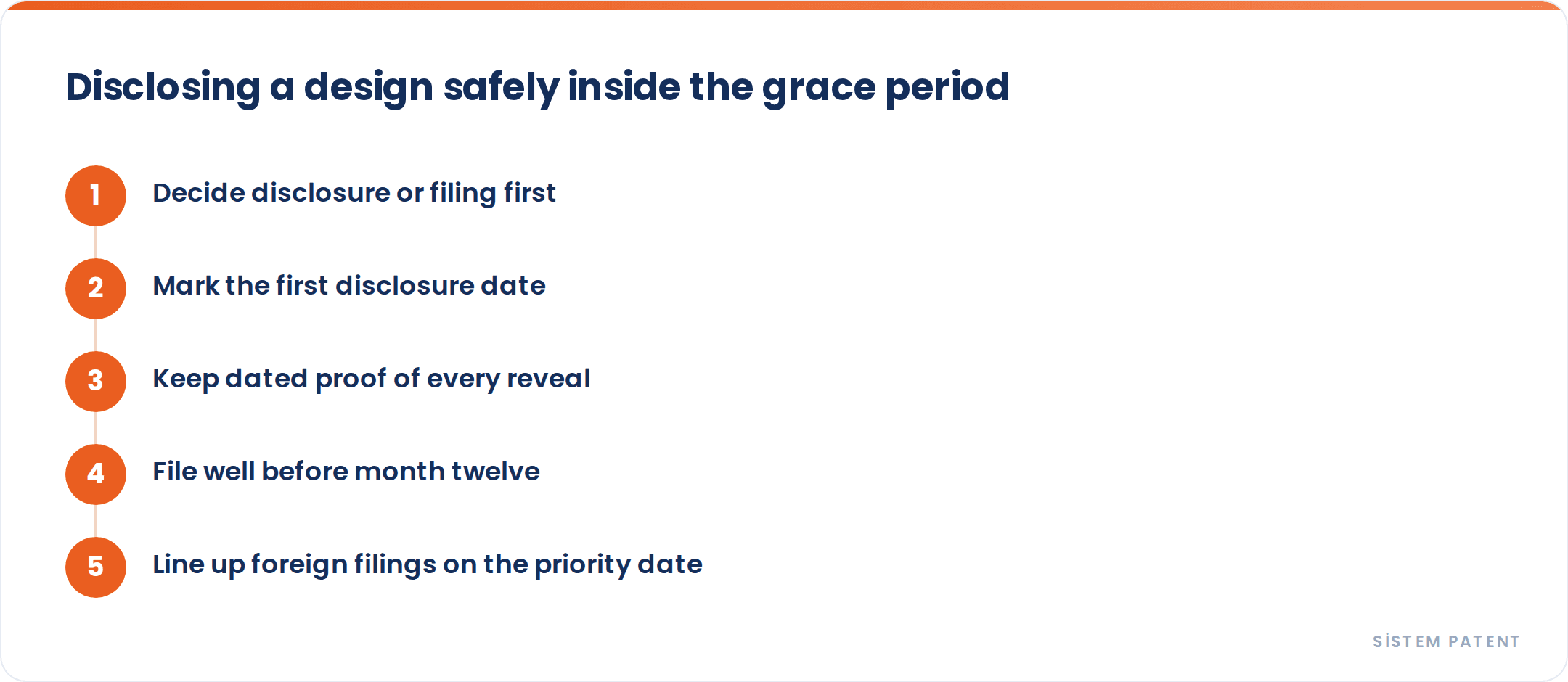
The cleanest strategy is the oldest one: file before you disclose. The grace period is a remedy for the designer who has already shown the work, or who genuinely cannot file before a fair or a sales meeting, not a licence to delay on purpose. Leaning on it as a routine plan invites three avoidable problems.
The first is evidence. If an examiner or an opponent later challenges novelty, you have to prove that the earlier disclosure was yours and that it fell inside the twelve months. That means keeping dated records of every reveal: the fair you exhibited at and when, the post and its timestamp, the buyer meeting, the lookbook you sent. Designers who rely on the grace period casually often cannot reconstruct these dates two years later, and a defence you cannot evidence is no defence at all.
The second is the gap before filing. Between your first disclosure and the day you file, you have no registered right. You cannot stop a copyist with a registration you do not yet hold, and if a fast-moving competitor files a similar design before you do, you are forced onto the back foot, arguing about who disclosed what and when instead of simply pointing to your registration. The grace period keeps your own application alive; it does not give you a weapon to use against anyone in the meantime.
Document the first disclosure date the moment it happens
If you are going to show before you file, build the proof in real time. Photograph the booth with the design and a dated fair sign, save the platform timestamp on the launch post, keep the email that sent the catalogue to a buyer, and note the date the prototype left your studio. A simple dated log of who saw the design and when turns the grace period from a hopeful argument into a documented fact. This habit costs nothing and is the difference between a clean registration and a contested one.
The biggest trap is assuming every country works like Turkey
Turkish and European Union design law share the same generous twelve-month grace period, so a designer planning to protect a design in both can show the work first and still file cleanly on both sides within the year. That symmetry breeds a dangerous habit, because it does not hold everywhere. A number of important markets give a much shorter grace period, restrict it to specific kinds of disclosure such as official exhibitions, or grant no general grace at all. In those countries, the Milan fair that your home filing forgives is an absolute novelty bar: the design is already public, so it can never be registered there.
This is where a single national window quietly decides your global options. The day you disclose, you start a clock not only in Turkey but, in effect, against every no-grace country you might later want to enter, and in those places the clock has already run out. If export markets are anywhere in your plan, the order of operations flips: file first, at least a priority application, and only then show the design, so that your filing date is locked in before any disclosure can be held against you abroad. A timely home or priority filing also carries a six-month priority right into foreign applications, which is a separate and equally important reason not to disclose before you have filed something.
For protection beyond Turkey, the practical routes are an EU industrial design registration for the European market and the international design registration under the Hague System for a basket of countries through one application. Neither rescues a design that was disclosed before filing in a market with no grace period, which is exactly why the disclosure-versus-filing order has to be settled before the first public showing, not after.
What to do before you show a new design
The grace period is a genuine protection, and for the designer who has already exhibited or who cannot avoid an early reveal, it is often the thing that saves the registration. Used as intended it works well. Used as an excuse to file late, it leaves you with an evidentiary burden, an unprotected gap, and a set of foreign markets that may already be closed.
If the design is not yet public, the right move is to lock the filing date first. A short clearance check and a prompt application give you a priority date you can build on, and the public reveal then sits safely behind a right you already own. If the design is already out in the world, the grace period is your friend, but treat the twelve months as a hard countdown and file well before it expires. Our design agents can confirm where you stand in that window, document the disclosure properly, and align your design registration with any export plans so that an early showing in Turkey does not quietly forfeit your industrial design registration in the markets you are heading into next.
Picked for You
Related Articles

Registered vs Unregistered Design Rights: What You Get for Free and Why It Is Rarely Enough
Read More →
Turn Your Design Investment Into a Tax Position: Design Centres, R&D and IP Incentives
Read More →