
The Patent Examination Journey, Step by Step
You filed your patent application months ago, the official receipt is sitting in a folder, and then nothing visible happens for a long stretch. That silence is not inactivity. Behind it, your application is moving through a defined technical pipeline at TÜRKPATENT (the Turkish Patent and Trademark Office), where an examiner is comparing your invention against everything that came before it. Knowing what each stage actually does, and where your input changes the outcome, turns that quiet period from a black box into a process you can steer.
This is the journey from a freshly filed application to a granted patent under the Industrial Property Code (Law No. 6769): the formal check, the search report, substantive examination on novelty and inventive step, the written opinions you receive, the responses you file, and the claim amendments that quietly decide how broad your final right will be.
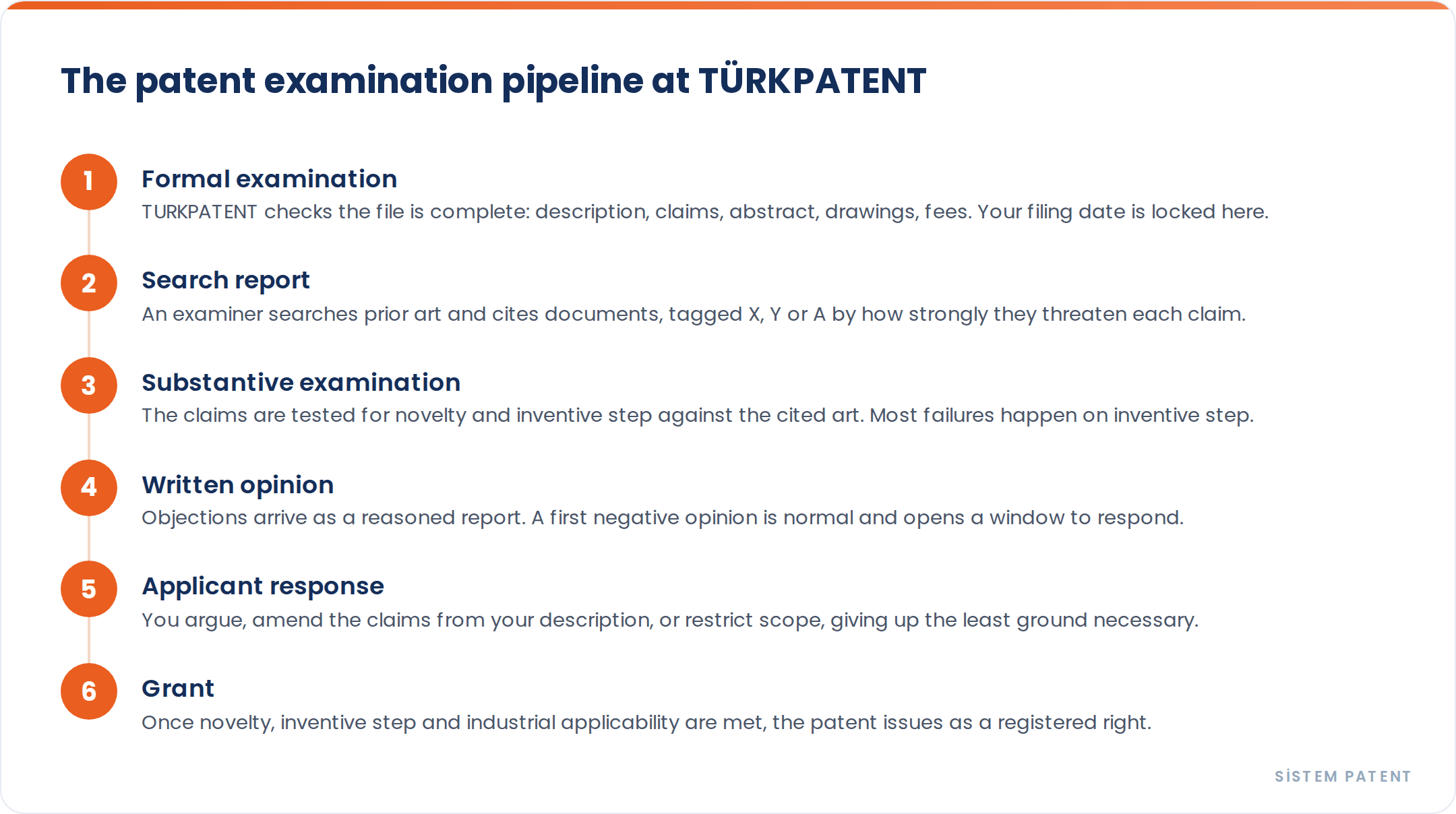
The formal examination only checks whether the file is complete
The first gate is administrative, not technical. TÜRKPATENT confirms that the application carries everything it needs: a description, at least one claim, an abstract, drawings where the invention calls for them, the applicant and inventor details, and the paid fees. Nobody is judging whether your invention is new yet. They are checking that the document is a proper patent application at all.
Deficiencies at this stage are common and usually fixable. A missing drawing reference, an abstract that runs too long, an unpaid item: the office issues a notice and gives you a set period to correct it. The point worth internalising is that your filing date is already locked the moment a complete-enough application lands, and that date is the anchor for everything that follows. It fixes the cut-off for what counts as prior art against you, which is exactly why getting the application on file early, even before the polish is perfect, protects your position. The detail of preparing that patent application properly is its own discipline, and the cleaner the file, the faster it clears this gate.
The search report is a map of everything that threatens your novelty
Once the file is in order, the application moves to the search. An examiner reads your claims, identifies the technical field, and searches patent literature and published technical sources for documents that disclose the same or similar solutions. The output is a search report: a list of cited documents, each tagged with a category that signals how dangerous it is to your claims.
Those category letters carry real weight. A document marked X is, on its own, capable of destroying the novelty or inventive step of a claim. A Y document becomes a problem when combined with another reference. An A document is merely background, relevant context that does not directly block you. Reading the report is therefore not about counting how many documents were cited. It is about seeing which of your claims each citation actually reaches.
This is also the moment that rewards anyone who ran a serious prior-art search before filing. If you already mapped the closest existing solutions, the official search rarely surprises you, and you drafted your claims to sit in the clear space the search revealed. Applicants who skipped that step often meet their toughest prior art here for the first time, with far less room to manoeuvre.
Substantive examination is where novelty and inventive step are actually decided
The search report tells you what exists. Examination decides what your claims are entitled to in light of it. Here the examiner applies the two tests that sit at the centre of patentability. Novelty asks a binary question: is every feature of the claim found, together, in a single prior document? If one reference shows the whole combination, the claim is not new, and no argument about cleverness rescues it.
Inventive step is the harder, more interpretive test. The question is whether the invention would have been obvious to a skilled person in the field, starting from the known art. An examiner typically identifies the closest prior document, pinpoints the difference between it and your claim, and asks whether bridging that gap required genuine invention or merely a routine adaptation an ordinary engineer would have tried. Most patents that fail, fail here, not on raw novelty.
Why the claims, not the description, carry the whole fight
It helps to remember what is actually being examined. Your description and drawings explain the invention in full, but your legal protection is defined only by the claims. The examiner tests the claims word by word against the cited art. A feature buried in your description but absent from the claims gives you nothing, while an unnecessarily broad claim word invites a rejection that a tighter wording would have avoided. The whole examination is a negotiation over claim language.
A written opinion is an invitation to respond, not a final refusal
When the examiner finds an objection, you do not simply receive a rejection in the post. You receive a reasoned written opinion or examination report setting out the grounds: which claims are objected to, which documents are cited against them, and why. This is one of the most misread moments in the whole process. A first negative opinion is normal, even expected, on applications with meaningful claim breadth. It is the start of a dialogue, and you are given a defined window to answer.
You generally have three moves, and they are not mutually exclusive:
- Argue. Explain why the examiner has misread a cited document or why the claimed combination is not in fact disclosed or obvious. A well-reasoned argument can preserve the claims exactly as filed.
- Amend. Rewrite the claims to add a feature that distinguishes them from the cited art, drawing that feature from your original description. You cannot add new matter that was not in the application as filed, which is, again, why a rich description filed at the start is so valuable.
- Restrict. Narrow the scope or cancel the claims that cannot be saved, keeping the protection you can actually defend.
The skill lies in giving up the least ground necessary. Every word you add to a claim to escape an objection also narrows what competitors are barred from doing later.
How claim amendments quietly shape the patent you end up with
Most granted patents look different from the application that was filed, and the difference is almost always the claims getting narrower. Each round of examination tends to push you toward more specific language: a general "fastening means" becomes a particular mechanism, a broad range tightens to the values you actually demonstrated. That narrowing is the price of getting past the prior art, but it is also a strategic decision with long consequences.
Amend too aggressively and you walk away with a patent so specific that a competitor designs around it by changing one inessential detail. Refuse to amend at all and you risk losing the claim entirely. The art of prosecution is finding the wording that clears every cited document while still covering the commercial heart of the invention. This is where an experienced patent agent earns the fee, reading the examiner's real concern and conceding precisely enough to move forward without gutting the right.
Once the examiner is satisfied that the claims meet novelty, inventive step and industrial applicability, the application proceeds to grant. The decision is published, the patent issues, and your protection now runs as a registered right rather than a pending application. From there the work shifts from securing the patent registration to maintaining and enforcing it across its term.
Reading the pipeline as a sequence you can influence
The examination journey rewards applicants who understand it. A complete file clears the formal gate without delay. A claim set drafted against a real prior-art search meets the search report with few surprises. A measured response to the first written opinion, arguing where the art is weak and amending only where it must, carries the strongest possible claims through to grant. None of this is luck. It is the difference between treating examination as something that happens to you and treating it as a process you take part in.
If you have an invention heading toward filing, the moves that matter most happen before the examiner ever opens the file: a thorough search, a carefully scoped claim set, and a description deep enough to support every amendment you might later need. Our team handles each stage of the patent application and examination process, and is glad to talk through where your invention sits before you commit to a filing.
Picked for You
Related Articles

Turning University Research Into Patents and Revenue
Read More →
The One Disclosure That Kills a Patent: Novelty and the Grace Period Before You File
Read More →