
Patent or Utility Model in Turkey: How to Choose the Right Protection
An engineer walks into our office with a clever bracket that snaps two components together and cuts assembly time in half. It works, it sells, and a competitor will copy it within a year. The first question is rarely the one the inventor expects. It is not how do we patent this. It is should this be a patent at all, or a utility model? The two rights protect inventions in Turkey, but they are built for different situations, and picking the wrong one costs either money or strength.
Both the patent and the utility model live in the same statute, the Industrial Property Code (Law No. 6769), and both are granted by TÜRKPATENT (the Turkish Patent and Trademark Office). From the outside they look similar: you file an application, you describe the invention, you end up with an exclusive right you can enforce against copyists. The differences are in how hard the office examines the invention, how long the protection lasts, and how high the bar sits for the invention to qualify in the first place.
A utility model trades depth of right for speed and cost
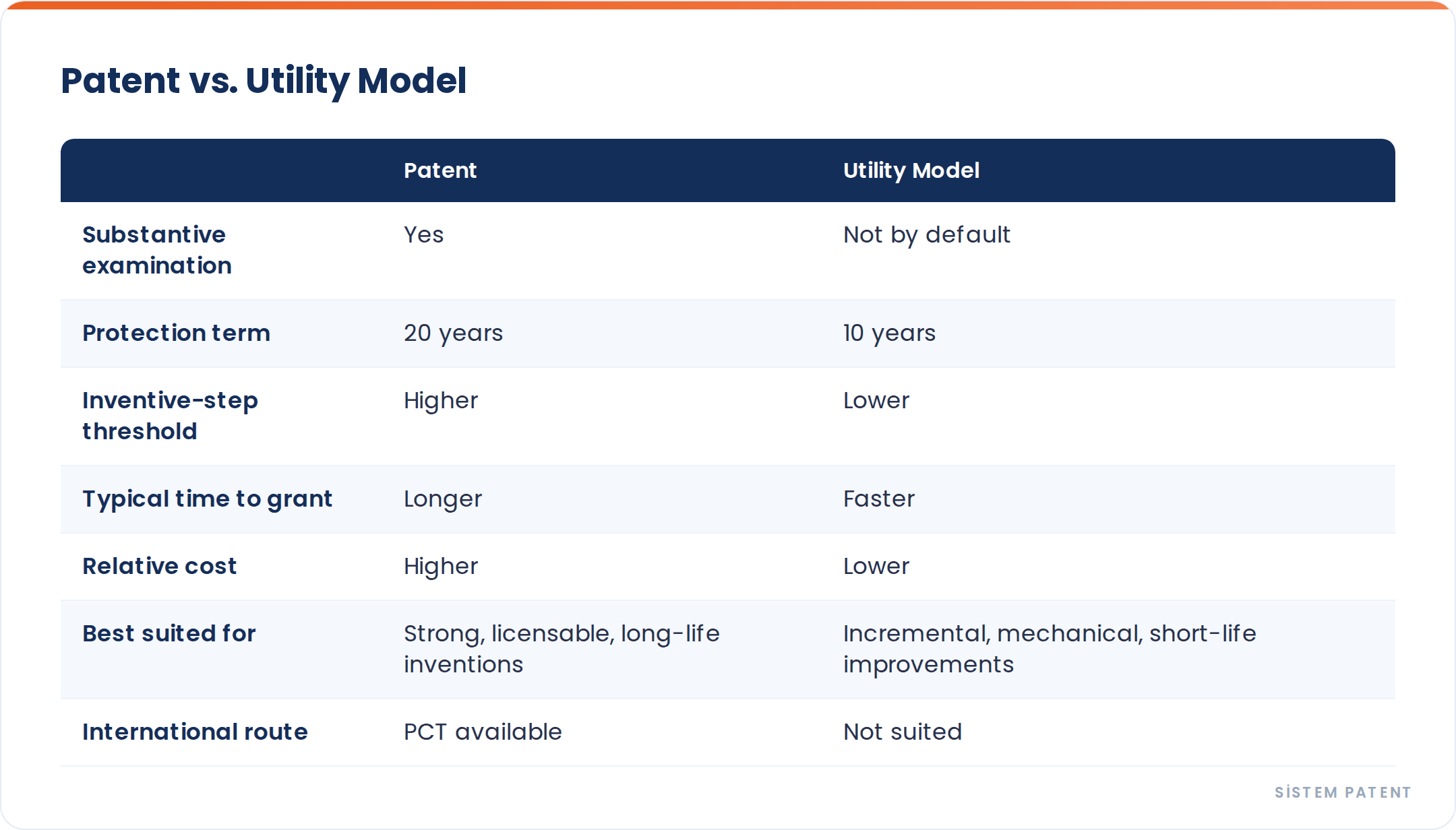
The utility model, the faydali model in Turkish, is the lighter route. Its defining feature is that TÜRKPATENT does not, by default, run a substantive examination of novelty before granting it. The office checks the formalities and a search report is prepared, but the deep merits review that a patent goes through is not part of the standard utility model path. That single difference drives almost everything else about the right.
Because there is no full merits examination by default, a utility model is generally faster to obtain and lower in cost to reach grant. The inventive-step bar is also lower. A patent has to clear a meaningful threshold of non-obviousness; a utility model asks less of the invention on that front, which is exactly why it suits incremental improvements that a patent examiner might reject as too small a step.
The trade-off is term and strength. A utility model protects the invention for ten years from the application date, with no renewal beyond that. Because the right was granted without a full novelty examination, its presumption of validity is thinner, and an opponent can attack it on prior art that was never weighed by the office. It is a real, enforceable right, but it is a lighter one.
A patent is the stronger, longer right, with a harder entry
A patent runs the full course. TÜRKPATENT conducts a substantive examination, weighing the invention against the prior art for novelty and inventive step before it grants. That examination is the reason a granted patent carries more weight. It has already survived the office's scrutiny, so it is harder for a competitor to knock out and more persuasive in a licensing negotiation or a court.
The term reflects that strength. A patent protects the invention for up to twenty years from the application date. The inventive-step requirement is genuinely higher: the invention has to be more than an obvious tweak to someone skilled in the field. And the patent is the route that connects to the rest of the world. If you intend to file abroad through the PCT (Patent Cooperation Treaty), build a licensing program, or attract an investor who will run due diligence on your portfolio, the examined patent is the asset that holds up.
Some inventions cannot be a utility model at all
This is the point inventors most often get wrong, and it can decide the question before budget or strategy ever come up. Under Law No. 6769, the utility model is not available for every kind of subject matter that a patent can cover. The route is oriented toward products and technical devices. Certain categories are outside its scope, and in broad terms that includes processes and methods as well as chemical and biological substances.
The practical consequence is direct. If your invention is at heart a manufacturing process, a method of doing something, or a new chemical or biological composition, the utility model may simply not be open to you, and a patent becomes the only protective path rather than a strategic choice. We deliberately speak about these exclusions in qualitative terms, because the precise boundaries turn on how the invention is framed and claimed. Before you commit to a route, the eligible category for your specific invention is worth confirming with a patent agent who can read it against the statute. A grounded patent search early on also tells you whether the prior art leaves room for either right in the first place.
How to actually choose between the two
Once eligibility is settled, the decision comes down to a handful of honest questions about the invention and the business behind it.
Budget and speed
If the budget is tight and the product needs protection on file quickly, the utility model is the pragmatic answer. It reaches grant faster and at lower cost, which matters when a small company is trying to put a marker down before a competitor moves. The official fees for either route are set by TÜRKPATENT and adjusted periodically, so treat current figures as something to confirm rather than assume.
How defensible the right has to be
Ask how likely you are to end up enforcing the right, and against whom. If you expect to send cease-and-desist letters, face a well-resourced rival, or litigate, the examined patent gives you a far stronger hand. A right that already passed the office's novelty review is harder to invalidate when someone pushes back.
Whether you will license or go abroad
Licensing deals and foreign filings reward the patent. An examined right is what sophisticated counterparties and foreign offices expect, and the PCT route for international protection is built around patents. If the plan is to license the technology or sell it in other markets, lean toward the patent from the start.
How long the product will sell
Match the term to the commercial life of the product. A mechanical improvement to a fast-moving consumer item that will be obsolete in a few seasons rarely needs twenty years of protection; ten years through a utility model fits its life and its economics. A platform technology you expect to build a decade of business on justifies the longer, stronger patent.
A common pattern: file the patent, keep the utility model as a fallback
The two rights are not strictly either-or. A frequent strategy is to pursue the stronger patent while keeping the utility model available as a faster, more certain fallback for the same invention, so a borderline inventive step does not leave the product unprotected. Whether that works for your case depends on the specifics and on timing, which is one more reason to map the route with a patent agent before filing rather than after.
The honest summary is that neither right is better in the abstract. The utility model is the efficient choice for incremental, mechanical, or short-life improvements where speed and cost matter more than the depth of the right. The patent is the choice when the invention clears a real inventive step and the business needs a durable, examined, internationally portable asset. If you want help reading your invention against both, our teams handle patent registration and utility model filings from the first assessment through grant, and the early call is usually the one that saves the most.
Picked for You
Related Articles
Turning University Research Into Patents and Revenue
Read More →
The One Disclosure That Kills a Patent: Novelty and the Grace Period Before You File
Read More →