

Who Owns an Invention Made by an Employee? Service Inventions Under Turkish Law

An engineer at a Turkish manufacturer solves a production problem with a clever new mechanism over a long weekend, partly at home. Three months later the company wants to file a patent. The engineer assumes it is hers because she thought of it; the employer assumes it is his because he pays her salary. Both are partly wrong, and the law that settles it is more specific than either of them expects.
This is one of the most common ownership questions a law firm hears, and getting it wrong is expensive. A patent filed in the wrong name, or filed without following the statutory notification steps, can be challenged later by the very inventor who created it. The rules that govern this sit in the Industrial Property Code (Law No. 6769) and its service-invention regulation, and they apply whether or not anyone signed a contract about inventions.
Turkish law splits employee inventions into two kinds
The starting point is a distinction that decides everything that follows. Law No. 6769 separates what an employee creates into service inventions and free inventions.
A service invention is one an employee makes during the employment relationship, either while carrying out the duties assigned to them or largely on the back of the employer's experience, resources, or activity. The weekend mechanism above is almost certainly a service invention, because it grew out of the production knowledge the engineer gained on the job, even though some of the work happened at home. Location and clock time are not the test. The connection to the work is the test.
A free invention is everything else: something the employee creates that has no real link to the job or the employer's field of activity. A logistics-company accountant who invents a garden tool on her own time has made a free invention. The employer has no automatic right to it, though as we will see, even free inventions carry a notification duty.
The inventor must notify the employer in writing, without delay
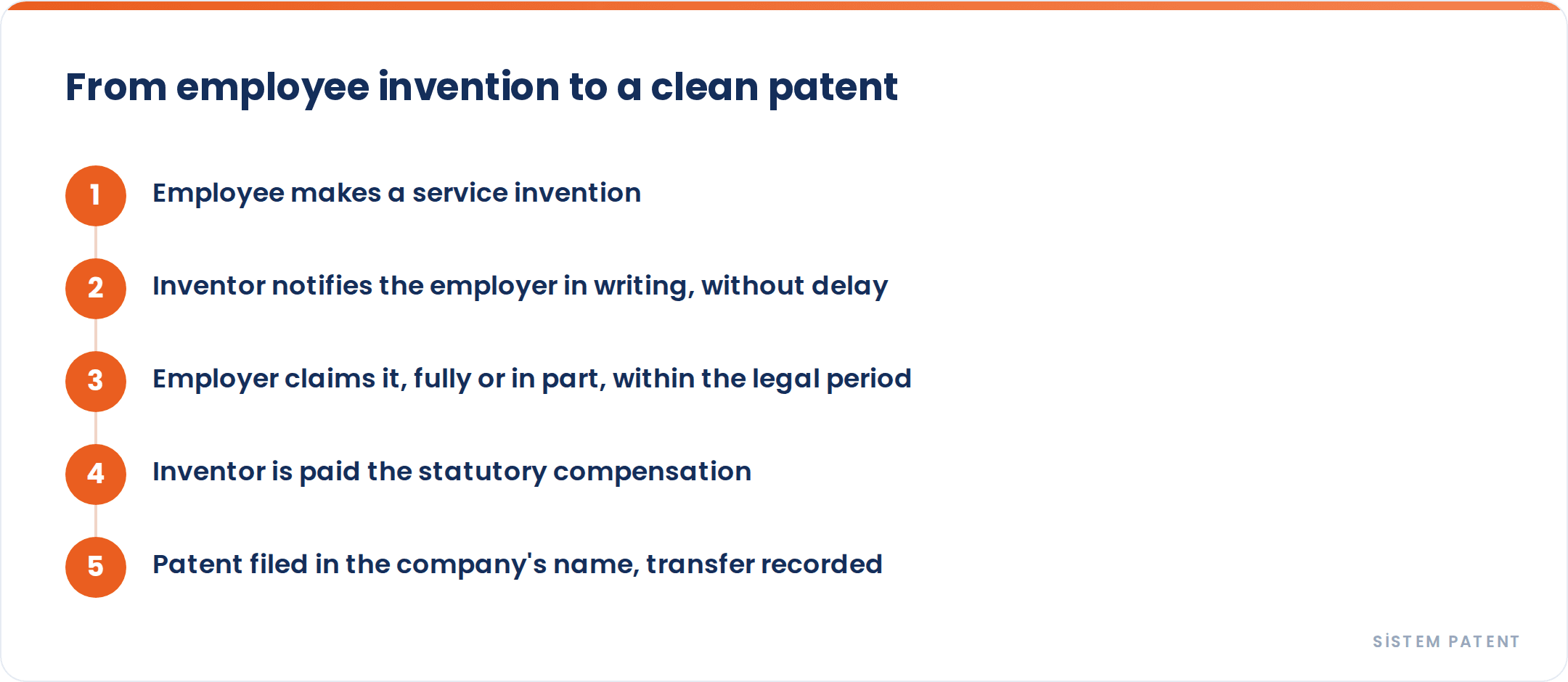
Here is the step that companies and employees both forget, and it is where most disputes start. When an employee completes a service invention, the law places a duty on the inventor to notify the employer in writing, without delay. The notification has to describe the technical problem, the solution, and how the invention was arrived at, with enough detail for the employer to understand what was created.
This is not a courtesy. The written notification starts the clock on the employer's right to claim the invention, and a clean, dated notice is the document everyone wishes they had when a dispute reaches a lawyer two years later. A verbal mention in a corridor does not count.
If more than one employee contributed, they notify jointly. Free inventions carry a lighter but real duty: the employee must still inform the employer of a free invention made during the employment, so the employer can check whether it truly falls outside its field. Only inventions that obviously have nothing to do with the employer's activity escape even this step.
The employer claims the invention, fully or in part
Once the notification arrives, the employer decides whether to claim the service invention. A full claim transfers all rights in the invention to the employer, who can then pursue patent registration in the company's name and build the asset into its portfolio. A partial claim takes a limited right, for example a licence, and leaves the rest with the inventor.
The claim has to be made within the period set by Law No. 6769, communicated to the inventor in writing. Timing matters more than most employers realise. If the employer lets the statutory period pass without a valid claim, the service invention becomes free, and the rights stay with the employee. A company that sits on a strong invention because the legal team is busy can lose it by silence.
While the employer is deciding, the inventor must keep the invention confidential and must not do anything that defeats a future patent. The employer, for its part, must treat the disclosed invention as confidential too. Premature publication by either side can sink the novelty the patent depends on.
A claimed invention is not free: the inventor is owed compensation
This is the part employers most often overlook. When the employer claims a service invention, the inventor is entitled to a reasonable compensation set by Law No. 6769. The right to this payment is statutory. It exists even if the employment contract is silent, and it cannot simply be waived in advance by a blanket clause.
The amount is not a fixed figure. It is worked out from factors the regulation lays down, broadly the economic value of the invention, the employee's role and position in the company, and the share the employer's resources and the employee's own contribution each played in creating it. A senior researcher hired specifically to invent, using a full company lab, sits at a different point on that scale than a line worker who solved a problem off their own initiative. The more the result owes to the individual rather than the job, the higher the compensation tends to run.
Disagreements over the figure are common and have their own resolution path under the regulation, including arbitration before the dispute reaches a court. Building a record of how the invention was valued, from the start, is what keeps these arguments short.
Universities and public research follow a related but separate track
Inventions made at universities and certain public research bodies have their own rules under Law No. 6769, with the institution holding rights and the academic inventor entitled to a defined share of any revenue the invention earns. The logic mirrors the private-sector regime, the institution provides the environment and the inventor gets a statutory cut, but the specific percentages and procedures differ. A research team should treat that as its own question rather than assuming the standard employer rules apply.
What employers should put in place before the dispute, not after
The service-invention regime works in the background whether or not a company prepares for it. The companies that come out ahead are the ones that turn the statutory framework into a routine instead of discovering it during a fight. Three measures do most of the work.
- An invention clause in employment contracts. A contract cannot strip away the inventor's statutory compensation, but it can confirm the notification duty, set out how inventions are reported and handled, and make the company's claim process predictable. Pair it with a clear confidentiality obligation.
- A real notification workflow. Give employees a simple, dated form and a named recipient for invention disclosures, and log every claim decision and its date. The whole regime turns on written notices and deadlines, so the paperwork is the protection.
- A recordal habit for ownership. When an invention moves from inventor to company, or later between group companies, the transfer should be documented and, where a registered right is involved, recorded through a proper patent assignment so the chain of title is clean if the patent is ever licensed, sold, or litigated.
Ownership of an employee invention is rarely decided by who had the idea. It is decided by who followed the steps Law No. 6769 sets out, and whether the compensation owed to the inventor was handled properly. If your business runs an R&D function, or even just employs people who occasionally solve problems in clever ways, it is worth getting the contracts and the workflow reviewed against the service-invention rules before a valuable invention forces the issue. Our team can walk you through both the intellectual property law side and the practical filing of any resulting patent.
Picked for You
Related Articles

Turning University Research Into Patents and Revenue
Read More →
The One Disclosure That Kills a Patent: Novelty and the Grace Period Before You File
Read More →