
Can You Trademark a Sound? Non-Traditional Marks in Turkey
Think of the four notes that play when a certain laptop powers on, or the short jingle that ends a fast-food ad before you have even seen the logo. You recognise the company from the sound alone, with your eyes closed. That recognition is exactly what trademark law is built to protect, and in Turkey a sound can be registered as a trademark in its own right.
Most business owners assume a trademark is a name or a logo. That was the legal reality for a long time, when the rules required a mark to be shown graphically on paper. The Industrial Property Code (Law No. 6769) changed the frame. A sign can now be a trademark if it distinguishes one undertaking's goods or services from another's and can be represented in the register in a clear and precise way. Nothing in that test says the sign has to be visible. A jingle, a chime, a spoken phrase set to a melody: each can function as a source identifier, and each can be filed.
The catch is that sound marks live or die on two questions that do not trouble an ordinary word mark. Can you represent the sound precisely enough for the register? And is the sound distinctive enough that people treat it as a brand rather than as background noise? Get both right and you hold a genuinely powerful asset. Get either wrong and the application stalls before it reaches publication.
An audio file, not a written description, is what fixes a sound in the register
The old graphical-representation rule was the real barrier for sound marks. Applicants used to attach a stave of musical notation and hope it captured the mark. Law No. 6769 dropped the requirement that a sign be shown graphically and replaced it with a representation standard: the sign must be reproduced in the register clearly, precisely and in a way that lets anyone determine the exact scope of protection. For a sound, that points to one practical answer, an electronic audio file submitted with the application, so the register holds the sound itself rather than a translation of it.
This matters because the representation defines what you own. With a word mark the letters on the certificate are the right. With a sound mark the deposited recording is the right, and a third party, an examiner, or a court reads your protection straight off that file. A vague description such as "a cheerful three-note tune" fixes nothing, because two very different melodies could both answer to it. The audio recording removes that ambiguity. Where notation is used it supports the file rather than standing in for it.
The lesson for an applicant is to treat the sound asset with the same care as artwork for a logo. The recording you attach to the trademark application is the boundary of the right, so it should be the exact production version the public will hear, clean and final, not a rough demo you intend to polish later.
A sound has to be heard as a brand, not as a function of the product
Representation gets the sound into the system. Distinctiveness is what gets it registered. A sound mark has to do the one job every trademark does: tell the listener who is behind the goods or service. Some sounds clear that bar easily and some cannot clear it at all.
A composed signature works best. A short original melody, a branded jingle, a distinctive chime attached to a product or an app, these are arbitrary in relation to what they sell, so a listener learns to read them as a badge of origin. The Nokia ringtone and the sounds that established platforms attach to their software are the textbook shape of a registrable sound mark: invented, consistent, and tied to one source.
Several categories tend to fail. A sound that is merely the noise the product makes in normal use is treated as functional, the audio equivalent of a shape dictated by technical result, and the law keeps functional signs out of the register so one trader cannot monopolise an ordinary feature. The roar of a particular engine or the fizz of a drink being opened sits in dangerous territory for that reason. Commonplace sounds with no capacity to distinguish, a single plain beep, a generic notification tone, a few seconds of a well-known piece in the public domain, struggle for the same reason a generic word struggles: nobody hears them as one company's property. And a sound that misdescribes the product or misleads the public on origin runs into the same absolute grounds that block a deceptive word mark.
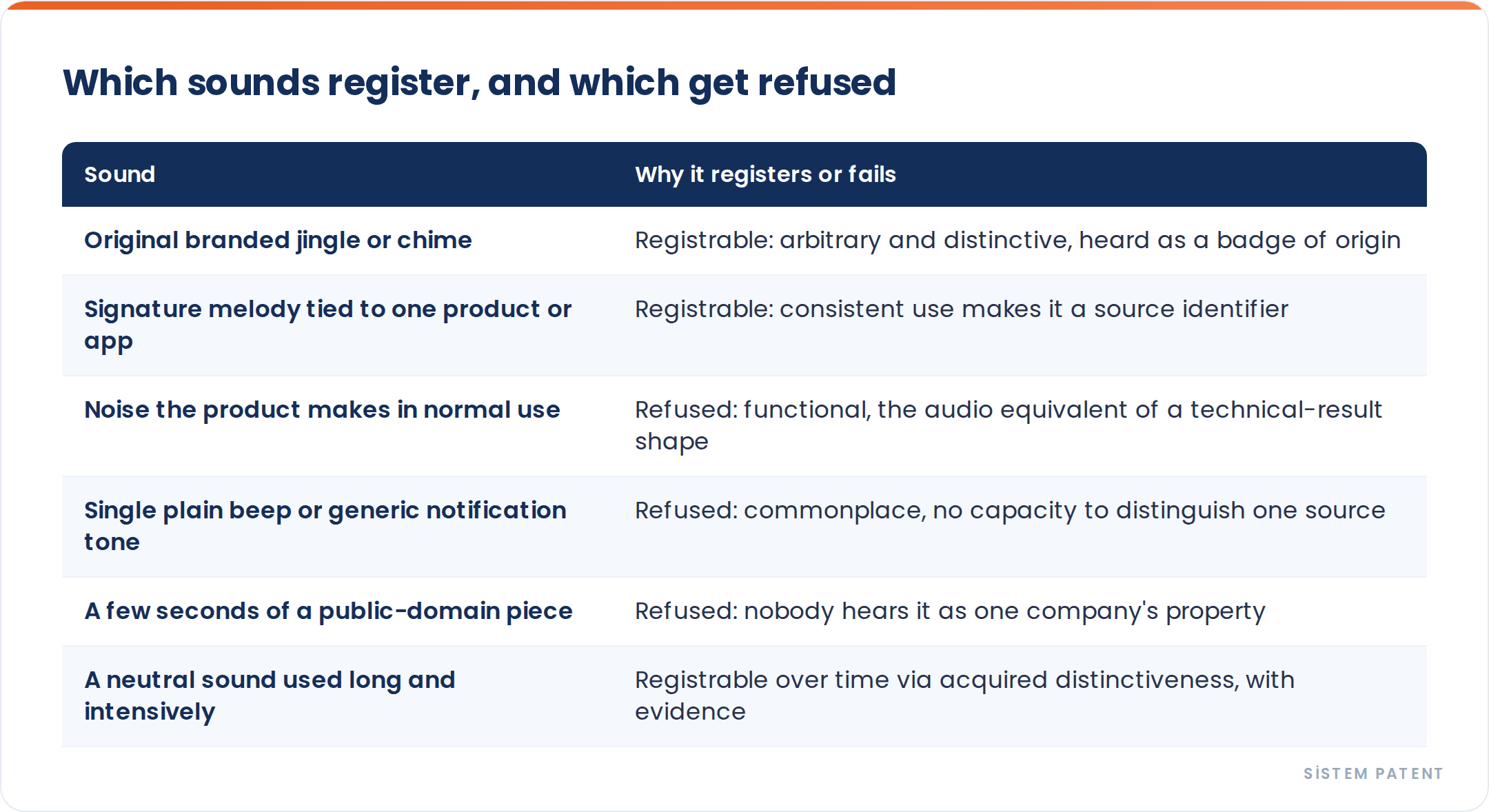
Distinctiveness is not always fixed at the start. A sound that means nothing to consumers on day one can come to identify a single source after long and intensive use, the same acquired-distinctiveness route that rescues a descriptive word mark. The evidence burden is real: you are proving that the public has learned to connect the sound with you, through sustained exposure across advertising and products. It is a slower and more expensive path than filing something inherently distinctive, which is the better argument for designing a strong, arbitrary sound from the outset.
A sound mark is registered for specific classes, exactly like any other mark
A sound mark is not a free-floating claim over a melody. It is registered against goods and services, under the Nice classification, just as a name or a logo is. Protection reaches the classes you file in and no further, so the same scoping discipline applies. If your audio signature plays inside a mobile application, you protect it in the relevant software and services classes; if it brands a chain of cafes, you cover the food and beverage and retail classes that match the business. Choosing the right Nice classes for a sound mark is the same exercise as for a word mark, and getting that coverage right decides how far the protection actually reaches.
The examination path is the same too. TURKPATENT (the Turkish Patent and Trademark Office) examines the application on absolute grounds, including the distinctiveness and functionality questions above, then publishes the accepted mark in the Official Trademark Bulletin. Publication opens the window in which the owner of an earlier, similar mark can oppose. With sound marks that comparison is its own discipline, because similarity is judged by ear: two melodies can look unrelated on paper and still sound close enough to confuse a listener. That auditory comparison is part of what makes a clean filing strategy matter from the start.
What a sound mark is worth, and when to file one
A registered sound mark gives you a right you can enforce against a competitor who adopts a confusingly similar audio signature, the same exclusive right that any trademark confers, applied to the ear instead of the eye. For a brand whose identity travels through audio, in broadcast advertising, in an app, through a voice assistant, in a physical space where customers hear before they see, that protection closes a gap a name-and-logo registration leaves wide open.
It earns its place when the sound is genuinely part of how customers recognise you, and when you have invested in making it consistent. A jingle used once is not a candidate. A signature you run across every touchpoint, year after year, is. If you are building a brand around a piece of audio and want to know whether it can be protected, the practical first step is to assess the sound against the distinctiveness and representation standards before filing, and our team handles that assessment and the trademark registration through to the deposit of the audio file. Read your audio identity the way the register will read it, and you turn a memorable sound into an asset you actually own.
Picked for You